Gold, Platinum, Scarcity and Optionality: Sibanye-Stillwater (Part I)

In 2007 the United States subprime market collapsed, due to (relatively) higher and rising interest rates combined with surging delinquency rates amongst this subsect of housing borrowers. In between mid-2007 and the fall of 2008, most people didn’t even realise the economy was about to suffer a financial crash and a subsequent deep recession. Lehman Brothers' collapse in September 2008 is usually seen as the beginning of the GFC, however one could argue that the subprime crisis was the real beginning.
A similar pattern is unfolding today, albeit an inverse one where interest rates are now too low. Most media outlets (CNN, FT, CNBC, BBC) believe inflation is falling and is yesterday's bad news, yet the reality is we are entering into a period of sustained inflation. Central banks are doing everything to cut base rates against this backdrop. Yet to combat inflation real interest rates must increase.
Of course the big tell is that in December the Fed returned to quantitative easing with a $40bn per month treasury buying program. Powell was at pains to mention that the bond purchases were not part of the Fed’s monetary policy, and did not mark a return to large-scale purchases of long-term debt. Where have we heard that from a Fed chairman before.
With the raising of this monetary white flag (and a return to inflation), the focus of this article is on the lesser spoken metal, platinum and one of the largest platinum group metal's producers in the world.
First, what is platinum. It is a rare, dense, silvery-white precious metal, that sits at the intersection between chemistry, geology and money.
The most notable case of platinum being used as currency was in East Russia in the early 19th century. As well as knowing what it is, it is also essential to understand what it is not, which is a promise, or fiat currency i.e. non-redeemable government produced ‘money’. Washington DC, Downing Street and Brussels can’t print nor debase platinum, meaning it is hard money. Hard meaning difficult to produce.
How hard one might ask? Well, it is more than a hundred times rarer than gold in production terms, incredibly complex to mine, and rarely found on its own in large deposits. Whilst it is mostly known for its use in catalyst converters in the automotive industry, the metal is widely used in the chemical industry, glass manufacturing, electrical industry, medical applications and in jewelry.
It would be fair to say that platinum is indirectly involved in almost all modern manufacturing through its role in catalysis, refining, materials processing, and energy production.
Prisoners of Geography
The majority of platinum is produced in only several places, namely aforementioned Russia, South Africa and to a lesser extent certain areas in North America.
As an aside and little bit of trivia, Johnson Matthey purchased bulk platinum from Russia in 1845, a time when the company’s primary business was predominantly in metal refining. Given they have been around a while perhaps demonstrates there is something in acquiring platinum early. Businesses do not survive for 200 plus years by accident.
The current mixed picture and a possible contrarian’s outlook
At present, platinum sits in a middle ground. Automotive demand is widely perceived to be in structural decline due to electrification, while investor interest remains muted following several years of weak prices. Unlike gold it is not seen as a 'money', although in fairness, gold isn't either by current policy makers.
SBSW also operates in a fairly 'hated' region. Most asset managers and institutional investors avoid South Africa completely due to political and economic risk. Those that do have mandates for the region tend to have minimal allocations. Also, mining in general is an underinvested sector, with most pension fund and asset managers avoiding the sector altogether due to ESG concerns.
Granted, the political environment in South Africa is volatile, so these risks are real. However whilst these can't really be mitigated, it is what in some way is providing the opportunity.
SBSW
Sibanye-Stillwater (SBSW), NYSE listed is primarily a platinum group metals producer and gold miner, a combination following the merger of Stillwater Mining and Sibanye Gold in 2017. With SBSW it is really two businesses in one, one of the world’s largest platinum producers and a top tier gold miner thrown in.
With PGM prices in the doldrums in recent years, the share price has been totally washed out due to several loss making years, and what their own investor relations team describe as a difficult environment.
SBSW however is a truly diversified precious-metals miner with large-scale operations in South Africa and the United States. In South Africa, it runs deep-level gold mines and some of the world’s most significant platinum-group metal (PGM) operations in the Bushveld Complex. In the US, it owns the Stillwater and East Boulder PGM mines in Montana, alongside a major PGM recycling and processing business at its Columbus metallurgical complex. The group also holds longer-dated optionality in lithium, copper and other strategic metals.
And of course what really jumps out is the significance of SBSW's asset base. The group may seem expensive due to the share price trading at 4x NAV, however those books values and capex spent have been recognised over decades. Shafts, processing plants, infrastructure and geological knowledge are sunk costs that cannot be easily replicated. The replacement values for this asset base would be multiples of current book prices, due again to inflation in the last five years.
SBSW — Key Valuation & Cost KPIs (Gold @ ~$5,000/oz)
| KPI | Metric | What it tells us |
|---|---|---|
| Share price (ADR) | ~$19 | Equity still priced for scepticism |
| Enterprise Value (EV) | $15.5bn | Full firm value incl. debt |
| Gold spot price | ~$5,000 / oz | Structural, not cyclical move |
| Gold AISC | $2,450–2,650 / oz | Very wide margins at current prices |
| Gold margin (spot – AISC) | ~$2,350–2,550 / oz | Exceptional operating leverage |
| Gold Mineral Resources | 48.8 Moz | Long-life inventory |
| EV / Gold Resources | $318 / oz | ~6% of spot gold |
| EV / Gold Resources vs margin | ~0.1× one year’s margin | Market values an ounce at a fraction of annual cash flow |
| SA PGM Resources (4E) | 180.8 Moz | Large, sunk-capital asset base |
| EV / SA PGM Resources | $86 / 4E oz | Implies deep pessimism on PGMs |
At a $5,000 gold price, SBSW is being valued at roughly $318 per ounce of gold in the ground — around one-fifteenth of spot and equivalent to barely one-eighth of a single year’s current operating margin per ounce — with PGMs and other strategic metals effectively valued as options.
To stress-test SBSW’s valuation, one can strip the business back to gold alone and ignore PGMs, lithium, copper and other optionality. To elaborate, at today’s share price (around $19 per ADR), the company trades on an enterprise value of roughly $15.5bn. This against reported gold mineral resources of 48.8 million ounces, which implies the market is valuing SBSW’s gold inventory at about $318 per ounce in the ground. This figure is not a gold price or target share price, but the present value the market is assigning to each ounce after allowing for mining costs, time, and industry risk.
At a $5,000 gold price and an all-in sustaining cost of roughly $2,500 per ounce, SBSW is currently generating margins of around $2,500 per ounce. Even after assuming that only half of reported gold resources are ultimately mined, and applying a very conservative valuation multiple to those margins to reflect South African operating risk and long mine lives, the implied enterprise value attributable to gold alone rises materially above today’s level. Under these restrained assumptions, a gold-only valuation supports an enterprise value more than double the current market valuation, translating into an indicative share price in the region of $45–50 per ADR. Importantly, this analysis assigns no value at all to PGMs or other strategic metals, meaning any recovery or re-rating outside gold would sit on top of this baseline rather than being required to justify it.
Gold-only valuation snapshot (illustrative)
| Item | Assumption / Result |
|---|---|
| Gold price | $5,000 / oz |
| All-in sustaining cost (AISC) | ~$2,500 / oz |
| Operating margin | ~$2,500 / oz |
| Gold mineral resources | 48.8 Moz |
| Assumed conversion to mined ounces | 50% (conservative) |
| Economic gold ounces | ~24.4 Moz |
| Implied gold-only enterprise value | >$30bn |
| Current enterprise value | ~$15.5bn |
| Indicative ADR value (gold only) | ~$45–50 |
| Value attributed to PGMs & others | Nil (upside optionality) |
Pacing
As a slight mea culpa but also as a confirmation of sorts to the opportunity. This article was planned and contemplated as early as mid-2025, when the share price was hovering around $8 to $9, and platinum itself priced at ~$1,500 per ounce.
The particularly strong moves in PGMs (and silver) whilst expected in the medium term, was not expected to be so strong in late 2025 and into 2026. In the meantime SBSW has moved much higher, breaking $15 early January 2026, and $20 briefly (26th January), before slipping back. However the good news is that the opportunity is still early.
There is a risk the price may fall back towards the mid-teens in the short-term, but like the silver and gold rallies, any pullbacks are likely to be limited and shallow. Like the metals rally to date, waiting on the sidelines for a better entry is also a real risk which must be considered.
Share price chart
Looking at the chart and as mentioned, as recently as 2021 SBSW reached the steady highs of $20, before retreating circa 70%. This being due to investors not believing the brief precious metal rally in 2022, however this sell off is unlikely to be repeated and once $20 is reached that level will more than likely be the new floor. In the same way that $2,000 gold, a previous all time high or ‘ceiling’, eventually turned into a floor and base for future rallies.
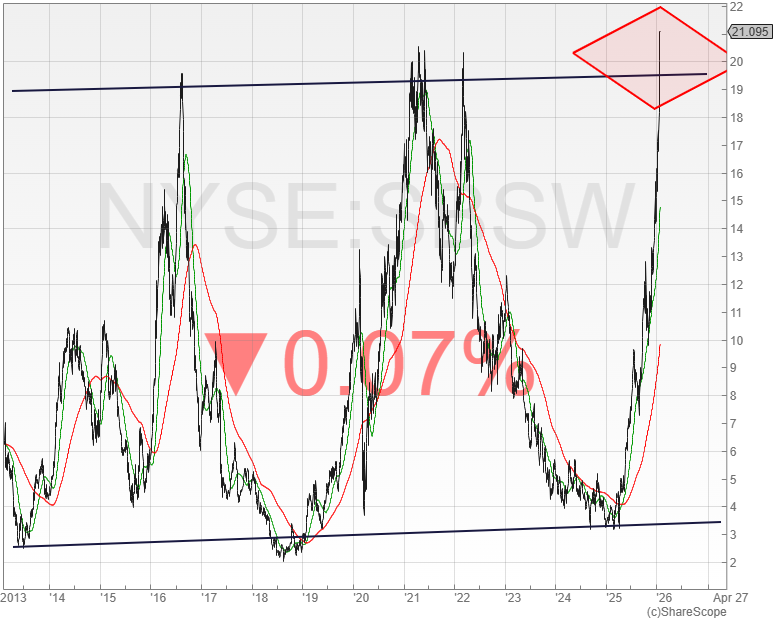
In the medium term SBSW is likely to reach $30, and thereafter much higher as gold and all other metals move higher. SBSW is a top tier gold producer which should serve as a base for the valuation.
A rough (and conservative) valuation based on indicative and recoverable gold resources only, gives a sum of the parts valuation of $40 per ADR, assuming a gold price of $5,000.
Near term forecasts indicate that gold is likely to reach $7,500 per ounce in 2027/2028. While this sounds like a stretch, for context on 5 January 2026 gold moved $110 alone, and on 27 January gold increased by $170 on the day. Previously these sorts of moves were unheard of, even unthinkable as recently as 2021/2022.
Looking ahead and keeping in mind SBSW's current undemanding valuation, what provides further upside and 'optionality' is platinum, and whether it reaches parity with gold. At the moment platinum trades at a significant discount to gold, but historically it has traded at a premium. Any closing of this gap and reversion to history would likely provide a real catalyst for the share price. More on this optionality in part II.
All told, Sibanye-Stillwater represents a compelling opportunity for investors willing to tolerate near-term volatility and jurisdictional risk, particularly as a means of defending against a renewed phase of dollar debasement driven by the Federal Reserve’s return to direct bond purchases.
The author holds shares in NYSE: SBSW.